
What is Copyright?
- Copyright is an intellectual property right that protects original content expressed in tangible forms. The owner of copyright has certain rights to prevent others from using their content without authorisation. As a property right, copyright can be assigned (i.e. you can transfer ownership of it to another person) or licensed (i.e. you can give permission to another person to use it). Copyright can also be used as security (e.g. as collateral for a loan). Copyright law exists alongside other laws that may need to be observed when using content in Singapore (e.g. the Personal Data Protection Act 2012 in relation to use of personal data and defamation law in relation to defamatory content).
Who are the Key Players in Singapore’s Copyright Ecosystem?
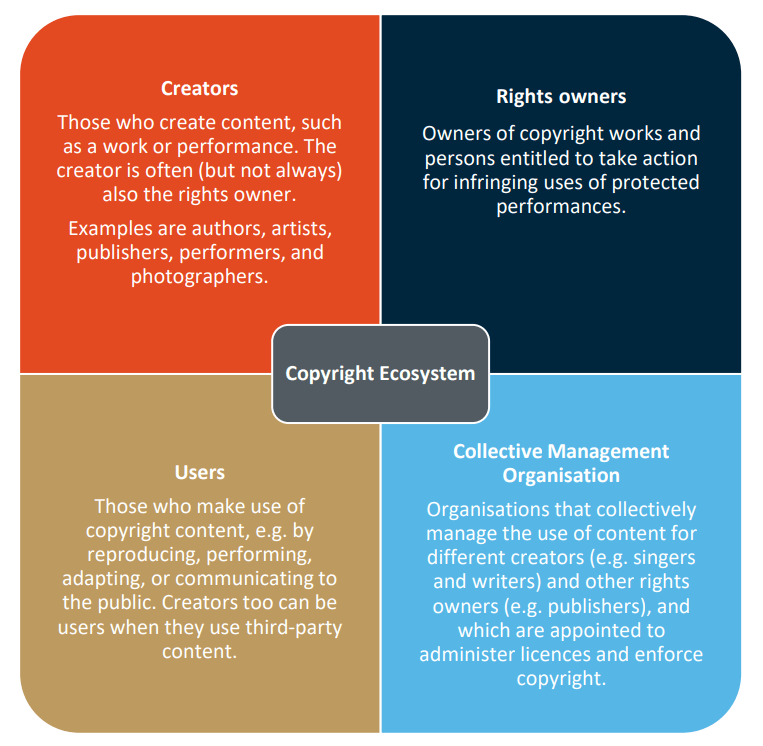
- Singapore’s copyright ecosystem includes the following key players: 1) Creators 2) Rights Owners 3) Users and 4) Collective Management Organisation.
A Closer Look at CMOs
CMOs are appointed by rights owners to facilitate large-scale royalty collection and monitor usage of content, thereby reducing the transaction costs involved. This intermediary role played by CMOs can benefit users (e.g. restaurants, cinemas, and shopping malls that play music) by facilitating their use of works, as well as creators
(e.g. the musician whose music is being played) by facilitating the payment of royalties to them for the use of their works. Different CMOs manage rights over different types of content. For example, if you wish to use music (e.g. to perform a song in public), you may check if COMPASS or MRSS can grant you the relevant licences.
To learn more about the main CMOs currently operating in Singapore, do read up more below at the end of this policy.
What Content does the Copyright Act Policy Protect?
- The Act protects a wide variety of content. Rights owners can control how their content is used and receive payment for such use. Others may need license(s) to use such content. Rights owners often require users to agree to comply with specific conditions, such as the payment of a fee, in exchange for the license to use the content.
To learn more about the overview of common types of content and when it may be necessary to obtain a license respectively, do read up more below at the end of this policy.
When is Copyright Infringed and What Are The Exceptions?
In general, copyright is infringed when content is used without its right owner’s authorisation and in the absence of any exceptions to infringement. Copyright may be infringed by:-
- Primary infringement, i.e. doing an act that falls within a right owner’s exclusive
rights. - Authorising infringement, i.e. authorising the doing of an act that falls within a right
owner’s exclusive rights. - Secondary or other types of infringement, such as commercial dealings in infringing
articles. Commercial dealings refer to selling; letting for hire; by way of trade, offering
or exposing for sale or hire; distributing for the purpose of trade; or, by way of trade,
exhibiting in public.
Exceptions to infringement are known as “permitted uses” in the Act. An unauthorised use of third-party content will not infringe copyright if the use falls within a particular permitted use and satisfies the relevant conditions of that permitted use. The Act recognises different categories of permitted uses in circumstances where it would be the public benefit to allow content to be used without infringing copyright, such as:
- fair use;
- educational uses;
- uses for computational data analysis and machine learning;
- uses by persons with print or intellectual disabilities; and
- uses by cultural and heritage institutions.
“Fair use” is important as it is a general exception that allows content to be used for any purpose,
so long as the use is fair. Whether the use is fair is decided by the courts (in the event of litigation)
based on factors in the Act. If a certain use does not fall within one of the more specific
categories of permitted uses, it could still be non-infringing if it falls within fair use.
When users access or use content, they are sometimes required by rights owners to agree to
certain contractual terms and conditions. Some of these terms may seek to prevent users from
benefiting from one or more permitted uses by excluding or restricting these permitted uses. Such
terms are potentially unenforceable under the contractual restrictions provisions in the Act.
To learn more on How copyright protection is obtained, Who owns the copyright to the respective content and more, please download the document from IPOS below.
Notes
In accordance to the Singapore Copyright Act Policy, last revised in 2021, the content listed on this webpage were taken from the IPOS (Intellectual Property Office of Singapore) and is only intended to be used as reference to highlight that all contents, media files, artworks, graphics and/or illustrations showcased on this website are not intended to be reproduced, printed, modified and are used in accordance to the 2021 Singapore copyright act policy. All rights are reserved and belongs to the respective creators and due credits are provided when images taken from other platforms are used on Kylynn’s Music Studio website for non-commercial use. All stock images used on the website are taken from pexels.com ‘s royalty free stock images library collection.
Do note that the attached document was last updated on 24 February 2023. You may download, view, print and reproduce this document without modifications, but only for non-commercial use. All other rights are reserved under IPOS.
 Kylynn's Music Studio