Frequently Asked Questions
General Questions
1. What are the benefits of learning music?
Studies have shown that music benefits both sides of the brain and helps aid in a child’s academics such as Mathematics and Science. For piano, it is the foundational instrument to start before learning other instruments in the orchestra like the strings or woodwind. The piano is also the only instrument that enables hand-eye coordination and the feet for the pedal, activating all parts of the body.
2. How old is the ideal age for a child to pick up music?
Each child has his/her own pace of learning, but ideally, a good age to start is 4-5 years old, where the gross motor skills and grasp of the spoken language are demonstrated.
3. Can adults learn music as well? How old is considered too old?
As a Music Teacher and Pianist myself, learning is never restricted to a certain age. I believe in lifelong learning for anyone of any age. Generally, my pool of students are aged between 4 to 11, but I have experience in teaching teenagers as well as adults.
Lessons Questions
1. Can I try and enrol for a few months before fully committing to learning piano?
Yes certainly! Our trial fees are chargeable at a one-time fee (of $50) and lessons are priced depending on the grade and duration of every 4 lessons of the month. For more information on lesson fees pertaining to our various grade levels’ classes, please do not hesitate to contact us below.
2. Are you able to teach other instruments other than the piano?
Piano has been the major instrument taught to my students so far. During lessons, some singing will be incorporated as well, as I have been in the choir at my church and had played simple chords on the guitar before. Singing is strongly recommended to be accompanied with learning the piano to help students with overall pitching and sight-singing.
Exams Questions
1. I would like my child to be assessed in Music. What and how is the examination syllabus like for piano?
Most students would go for grading in their musical journeys. I only teach one syllabus which is the ABRSM – The Associate Board of the Royal Schools of Music where it is based in London. The exam board is known to be the most established and recognised globally. There are practical/digital as well as theory exams made available. For more information please refer to this website in the link below:
Piano Types Questions
1. I do not have a piano at home currently. What are the types of piano that you can recommend for my child?
This is understandable especially if you first start off learning music and you are unsure which piano would best suit your needs. For beginners, you can consider these Japanese brand models such as Kawai and Yamaha. Teacher Kylynn highly recommends students to at least own a digital piano for beginners and upgrade to the upright piano after progressing to grades.
For more information please refer to their official websites below:
2. What are the differences between a digital and an upright piano?
For a digital piano, there are 61 and 88 keyboard types. An 88 keyboard is strongly recommended for long-term learning as the range of notes widens through the grades. Compared to an upright piano, the main difference is the touch of the keys. The keys in Digital pianos are generally harder than the Upright piano, where the keys are much more fluid. Hence the sound produced whether it is loud or soft can be heard clearly on an upright piano. We strongly recommend you to have an upright piano at home. (Note: In the case of graded exams, only upright pianos are allowed)
Learning Questions
1. What are the learning developmental stages used to assess a child’s current learning ability in music?
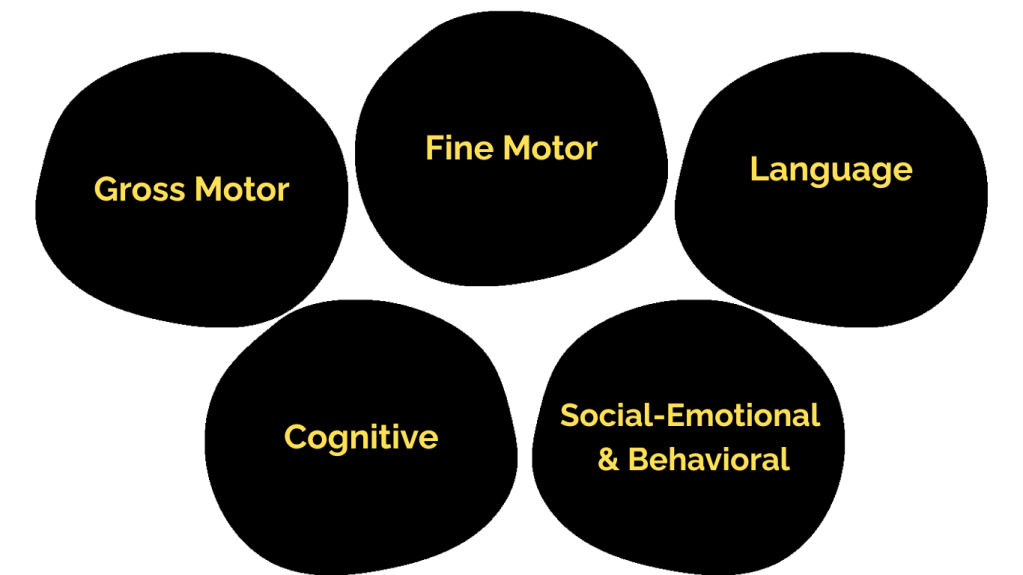
As a piano teacher with relevant experiences in teaching children piano from as young as 4-5 years old, there are typical developmental milestones that we’d observe and look out for to gauge every child’s current learning ability in music. These developmental milestones are a set of goals or markers that a child is expected to achieve during maturation. They are categorised into 5 domains / stages: Gross Motor, Fine Motor, Language, Cognitive, and Social-Emotional and Behavioral.
2. What are the learning developmental milestones used to assess a child’s current learning ability in music?
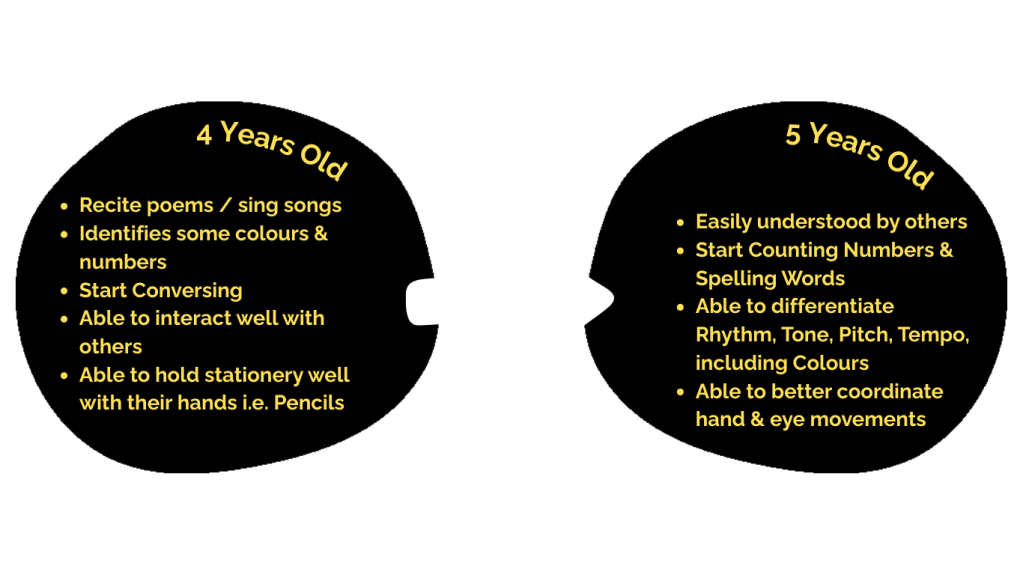
As the good age to start learning music is from 4-5 years old onwards, we can refer to the following list as a typical milestone guide achieved by children when they reach the age of either 4 or 5 years old. However, it’s worth noting that this list is not exhaustive and is not limited to only these, as other factors plays a part in it, and it varies based on each child’s learning style, pace and strength.
- Four years old: Likes to play with others, more imaginative play such as role playing, ability to recite a poem or sing songs, understands basic grammar, identifies some colours and numbers, identify shapes and patterns.
- Five years old: Differentiates between real and pretend, ability to listen to basic instructions, easily understood by others, tells stories, add and subtract numbers using fingers, writing letters and numbers.
3. What is the typical timeline most children would take to learn piano or music exploration in general?
For piano classes, most students would generally take about 1 year to progress for each grade. We encourage students to learn all 8 grades if it’s manageable for them consistently every year in order to enable them to have consistent exposure, practise and learning over the years. This is highly dependable on every child’s learning comfort, pace of learning and the commitments they might have on hand such as school or academics related matters and more.
For music exploration classes, most young children would generally take about 6 months to be familiar and used to identifying and understanding music on an introductory level, afterwards, they will need to progress on to the beginner’s class and this would generally take them about 1-2 years to achieve a fundamental level in music knowledge before they progress to Grade 1 piano classes, in order to allow them to have consistent learning over time. However, this is highly dependable on every child’s attention span, progress and personality.
 Kylynn's Music Studio